
Defending a Sacramento Financial Firm Against AI Phishing Attacks
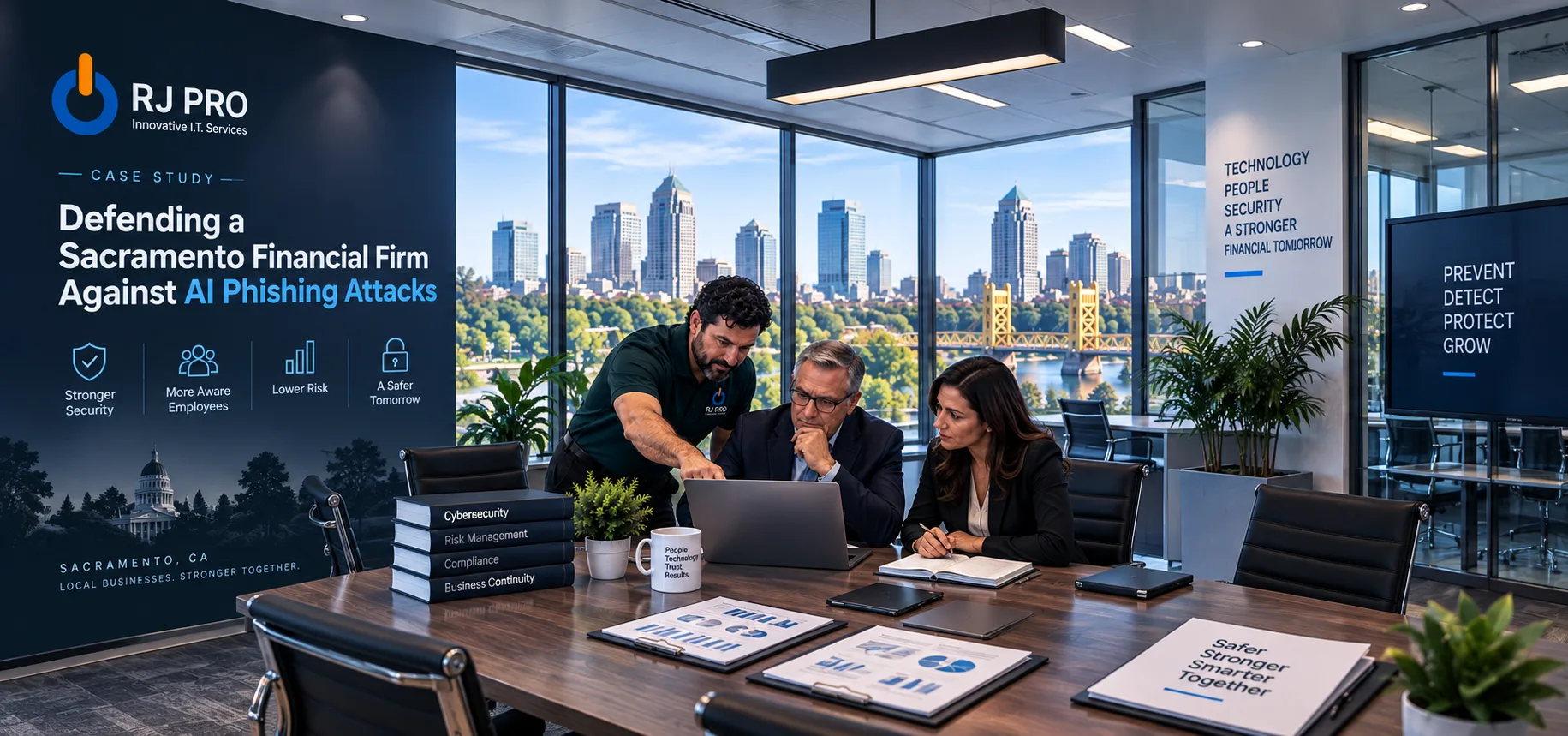
| At a Glance | |
| Industry | Financial services |
| Location | Sacramento, California |
| The problem | AI-assisted phishing and impersonation attacks targeting staff and business accounts |
| Starting point | Antivirus and basic email filtering, largely reactive security |
| What we did | Security assessment, then a layered rebuild across accounts, email, endpoints, monitoring, staff training and recovery |
| Headline result | Simulated phishing click rate fell from 16% to 4.5%, a 72% reduction |
The Challenge
The firm was being targeted by phishing attacks that no longer looked like phishing.
The emails were well written and convincing. They appeared to come from trusted vendors, executives, financial institutions and internal contacts, and they referenced the kind of business the firm actually does. The usual advice staff had absorbed over the years, watch for bad spelling and odd phrasing, had stopped being useful.
The attempts arriving included:
- Fake account verification requests
- Credential-stealing login pages built to mirror real ones
- Fraudulent invoice and payment requests
- Executive impersonation
- Vendor impersonation
- Malicious links and attachments
- Direct requests for sensitive financial information
The firm was not unprotected. Antivirus was in place and email filtering was running. The problem was that both were built for an earlier generation of attack, and neither addressed what happens when a convincing message reaches an employee who has no reason to doubt it.
The Approach
RJ PRO Tech Group started with a security assessment rather than a product recommendation. The purpose was to find where this firm specifically would fail if a phishing attempt succeeded, then close those gaps in order of risk. The work that followed covered six areas: accounts and access, email security, endpoint protection, monitoring, staff awareness, and backup recovery. Each is described below with what changed. The engagement is delivered as ongoing managed cybersecurity.
1. Strengthened Account and Access Security
Most successful phishing attacks end with a working password. That makes account protection the first place worth looking, because it determines whether a stolen credential becomes an incident or a dead end.
RJ PRO reviewed user accounts, password practices and authentication controls across the firm, identifying which accounts would be most valuable to an attacker. Multi-factor authentication was then strengthened across the critical business accounts, including the ones that had been missed.
| BEFORE
4 critical accounts had no multi-factor authentication |
AFTER
All critical accounts protected with multi-factor authentication |
The effect is straightforward. If an employee’s password is captured on a fake login page, that password on its own no longer opens the account.
2. Strengthened Email Security
Email was the primary route in, so it received the most attention.
RJ PRO reviewed the firm’s email security configuration and strengthened protection against suspicious messages, malicious links and impersonation attempts. The aim was to reduce how often an employee ever reaches a dangerous page in the first place, rather than relying on them to recognize one.
| BEFORE
Basic filtering with limited protection against sophisticated impersonation |
AFTER
Enhanced email security controls and stronger phishing protection |
The email environment was also reviewed for suspicious forwarding rules and similar indicators, which are among the first things an attacker sets up after gaining access to a mailbox and among the last things anyone thinks to check.
3. Improved Endpoint Protection
Devices are where a malicious attachment or link does its work, and they tend to drift out of standard quietly. RJ PRO reviewed the firm’s workstations and brought endpoint security across employee devices up to a consistent standard as part of endpoint and workstation protection.
Each device was checked for:
- Outdated software
- Missing security patches
- Weak security configurations
- Unnecessary applications
- Endpoint protection coverage
- Other potential security vulnerabilities
| BEFORE
76% of devices met the recommended security standard |
AFTER
100% of business devices brought under the security standard |
The remaining quarter mattered more than the percentage suggests. Unmanaged or poorly protected endpoints are exactly where an attacker looks for a foothold, and a single one is enough.
4. Added Proactive Security Monitoring
Before the engagement, security issues came to light when an employee noticed something unusual and mentioned it. That model has an obvious limitation: it only catches what someone happens to see, and it catches nothing overnight or at a weekend.
RJ PRO introduced continuous monitoring with proactive alerting, so potential security events surface on their own rather than waiting for a user to report one. This runs alongside network monitoring and management and the firm’s day-to-day support.
| BEFORE
Primarily reactive, dependent on staff noticing and reporting |
AFTER
Continuous monitoring with proactive security alerting |
The practical shift is from finding out afterwards to finding out earlier. With account-based attacks, unusual sign-in activity is frequently the only visible sign that anything is wrong.
| Would Your Firm Spot This Before the Damage?
We’ll review your email protection, account security and monitoring, then tell you plainly where the gaps are. Fifteen minutes, no obligation. Or call us directly: (916) 345-3451 Valley Springs: (209) 920-4077 | help@rj-pro.net |
5. Reduced Employee Phishing Risk
Technology alone does not eliminate phishing risk. A convincing message that clears every filter still ends up in front of a person who has to decide what to do with it.
RJ PRO delivered practical security awareness training built around the attacks this firm was actually receiving, rather than generic material. Coverage included:
- AI-generated phishing emails
- Fake Microsoft and financial institution login pages
- Credential theft
- Fake payment requests
- Executive impersonation
- Vendor impersonation
- Malicious links and attachments
- Urgent requests for sensitive information
Staff were then tested with a simulated phishing exercise, which is the part that turns training into something measurable.
| BEFORE
Initial simulated phishing click rate: 16% |
AFTER
After training: 4.5%, a 72% reduction |
The exercise did something else worth noting. It identified which employees needed additional support, which meant follow-up training could go where it was actually required instead of being repeated at everyone.
6. Improved Backup and Disaster Recovery
A security strategy has to account for what happens after an attack, not only before one.
RJ PRO reviewed the firm’s backup environment and recovery procedures to confirm that critical business information could actually be restored if systems were compromised. Backups were running beforehand, which is the usual situation. What was missing was any regular test proving they would work. That is now handled as part of backup and disaster recovery.
| BEFORE
Backups running, but recovery procedures not regularly tested |
AFTER
Scheduled backup verification and recovery testing |
The difference is between assuming a backup works and knowing it does. Firms usually discover which one they had on the day it matters most.
The Results
Where the firm stood before the engagement, and where it stands now:
| Security area | Before RJ PRO | After RJ PRO |
| Critical accounts with MFA | 4 critical accounts unprotected | All critical accounts protected |
| Devices meeting security standard | 76% | 100% |
| Simulated phishing click rate | 16% | 4.5% |
| Email security | Basic filtering | Enhanced phishing and impersonation protection |
| Security monitoring | Reactive, user-reported | Continuous, with proactive alerting |
| Staff security awareness | Informal | Structured training plus simulation |
| Backup recovery testing | Not regularly tested | Scheduled verification and recovery testing |
The Bigger Improvement Was Not a Product
No single tool produced this outcome. What changed was the structure.
The firm now has multiple layers around its employees, accounts, devices, email and business data:
| MFA | Email Security | Endpoint Protection | Monitoring | Staff Training | Backup & Recovery |
That matters because of what it means when something goes wrong. If an employee fails to recognize a sophisticated phishing email, the business is not automatically exposed. The stolen password runs into multi-factor authentication. Unusual activity surfaces in monitoring. The device is under a managed standard. And if something does get through, recovery is a tested process rather than a hope.
Each layer creates another opportunity to detect or stop an attack before it becomes a business disruption. None of them is expected to work alone.
Why This Matters for Sacramento Financial Businesses
Financial firms hold exactly what attackers want: sensitive customer information, financial records, and credentials that reach accounts holding money.
The wider change is that phishing messages have become easier to write convincingly and easier to personalize, which removes most of the surface-level clues people were trained to look for. A business cannot reasonably expect every employee to identify every suspicious email, every time, on a busy afternoon.
The alternative is not better guessing. It is a layered setup where no single judgment call decides the outcome. RJ PRO’s approach to IT services for financial companies and cybersecurity services is built that way rather than treating antivirus as the whole strategy.
The Outcome
The firm moved from a primarily reactive security setup to a layered, proactive one.
Stronger account protection. Full endpoint coverage under a managed standard. Improved email security. Earlier visibility of threats. Measurably better staff awareness. And a recovery process that has been tested rather than assumed.
The point of the work was not only to respond to phishing attacks more effectively. It was to reduce the number of ways one of those attacks can turn into a serious business compromise.
Work With a Local Team
RJ PRO Tech Group has supported Northern California businesses since 2010, with offices in El Dorado Hills and Valley Springs and technicians covering Sacramento, Rancho Cordova, West Sacramento, Elk Grove, Roseville and Folsom. Alongside managed IT services we provide 24/7 monitoring, 24/7 helpdesk support and onsite response when something needs hands on it. Check the areas we service for your location, read more client case studies, or see what our clients say.
| Find Out Where Your Firm Actually Stands
Book a 15-minute discovery call with a local team that has supported Northern California businesses since 2010. We’ll tell you honestly what needs fixing first, and what can wait. Or call us directly: (916) 345-3451 Valley Springs: (209) 920-4077 | help@rj-pro.net |