
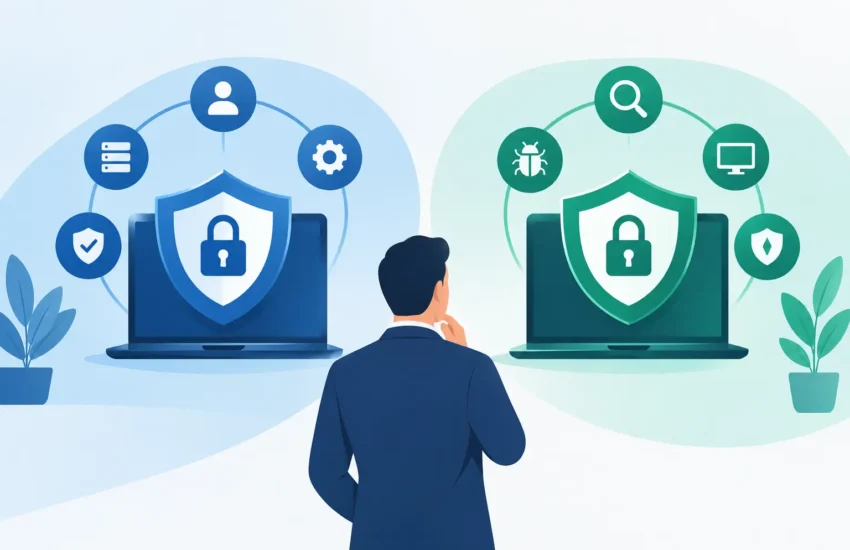
A suspicious login at 2:00 a.m. can become a business-stopping ransomware incident before your office opens. That is why the MDR vs EDR decision matters. Both can improve endpoint security, but they solve different problems: one gives your business advanced detection technology, while the other adds skilled people who monitor and respond when threats appear.
For a growing business, the real question is not which acronym sounds stronger. It is whether your organization has the time, security expertise, and around-the-clock coverage needed to turn threat alerts into fast, confident action. The right answer should reduce risk without creating another system your team has to manage.
MDR vs EDR: The Core Difference
EDR stands for Endpoint Detection and Response. It is security software installed on computers, servers, and other endpoints. Unlike traditional antivirus, EDR continuously records activity on those devices and looks for signs of malicious behavior, such as unusual file encryption, suspicious PowerShell commands, credential theft attempts, or unauthorized remote access.
When EDR detects something concerning, it can alert your team and, depending on the product and configuration, isolate a device from the network. That visibility is valuable. It helps security teams investigate what happened, identify affected devices, and contain an attack before it spreads.
MDR stands for Managed Detection and Response. It is a managed security service that combines detection tools, threat intelligence, security analysts, and an established response process. An MDR provider monitors alerts, investigates suspicious activity, separates meaningful threats from routine noise, and takes or recommends response actions based on the service agreement.
Put simply, EDR is primarily a technology platform. MDR is an ongoing security operation that often uses EDR as part of its toolset.
That distinction matters because buying EDR does not automatically mean someone is watching it at all hours. A dashboard full of alerts is only useful when qualified people can review them quickly and know what to do next.
What EDR Does Well
EDR can be an excellent choice for organizations with internal IT and security personnel who can actively manage it. It provides detailed endpoint visibility that basic antivirus software cannot match. When an incident occurs, your team can review device activity, search for indicators of compromise, and use the platform to contain affected systems.
For example, if an employee opens a malicious attachment, EDR may detect an unfamiliar process attempting to modify large numbers of files. It can generate an alert, provide a timeline of events, and potentially stop the process or disconnect the device. Your IT team can then investigate the user account, check whether other systems show the same behavior, and restore files if needed.
The trade-off is operational ownership. EDR generates alerts that require interpretation. Some will be harmless. Others may look minor at first but signal a larger compromise. Your business needs someone who understands the environment, can distinguish a false positive from an active attack, and can respond without delay.
EDR is often a good fit when you have a mature internal IT department, defined incident-response procedures, and staff available to monitor security alerts beyond standard business hours. It can also be appropriate when an organization wants to retain direct control over its security tooling and investigations.
Where EDR Alone Can Fall Short
Small and medium-sized businesses rarely have a dedicated security operations center. Even organizations with capable internal IT teams often have those employees focused on supporting users, maintaining systems, managing vendors, and completing strategic projects. Security alert review can become one more urgent task competing for limited time.
This creates a common gap: the business has good security software, but no one is consistently reviewing alerts overnight, on weekends, or during busy workdays. An alert may sit unresolved while an attacker moves through the network, attempts to access backups, or searches for financial and client data.
EDR also requires ongoing tuning. Security rules must be adjusted to account for your applications, workflows, and acceptable activity. Without that maintenance, alerts can become noisy enough that people begin to ignore them. Too many low-value notifications create alert fatigue, and alert fatigue creates risk.
For a law firm, medical practice, construction company, or financial organization, the consequences are not limited to a disrupted computer. A security event can delay projects, interrupt client service, expose confidential records, trigger compliance concerns, and create expensive recovery work.
What MDR Adds to the Equation
MDR is designed for businesses that need stronger threat detection and response without building an in-house security team. The service provides trained analysts and a defined process for reviewing, validating, and responding to suspicious activity.
Instead of expecting an office manager or general IT employee to decide whether an alert is serious, MDR analysts investigate it. They use threat intelligence, endpoint data, and known attack patterns to determine whether the activity requires action. If it does, they can isolate a device, escalate the event, or coordinate response according to the service plan.
This human layer is especially valuable during fast-moving attacks. Automated tools are essential, but automation does not always understand the context of your business. A security analyst can assess whether activity is expected, whether an employee’s account may be compromised, and whether the threat has reached other devices.
A quality MDR service should deliver more than a stream of alerts. It should provide clear communication about confirmed threats, actions taken, business impact, and recommended next steps. Your leadership team should not have to translate technical logs during an incident to understand whether operations are at risk.
The business benefits of MDR
For many organizations, MDR supports practical business outcomes:
- 24/7 monitoring helps reduce the time an attacker can remain active in your environment.
- Expert alert investigation reduces the chance that meaningful threats are missed or delayed.
- Faster containment can limit downtime, data loss, and disruption to employees and clients.
- Predictable managed-service costs make security planning easier than hiring and staffing an internal security function.
MDR does not eliminate every cyber risk. No security service can promise that. However, it gives a business a far better chance to identify and contain an attack early, when response options are broader and recovery costs are lower.
How to Choose Between MDR and EDR
The best choice depends on your internal capability, risk profile, and response expectations. Start with an honest assessment of who owns security after an alert appears.
If your team can monitor EDR alerts around the clock, investigate incidents, tune the platform, and follow a tested incident-response plan, EDR may provide the control and visibility you need. This is more common in larger organizations with dedicated security staff.
If your IT resources are stretched thin, MDR is usually the more practical option. It adds people and process to the technology, giving your business support when suspicious activity occurs outside office hours or during a demanding workday. This model is often a strong fit for businesses that handle sensitive client data, depend on uninterrupted access to systems, or must meet regulatory and contractual security expectations.
It is also worth asking what is included before comparing prices. Not every MDR offering provides the same level of monitoring, containment authority, onboarding support, reporting, or response coordination. Clarify whether the provider monitors all endpoints, how quickly confirmed threats are escalated, whether they can isolate devices, and what happens if an incident affects email, cloud applications, or backups.
Security Works Best as a Layered Plan
MDR and EDR are not substitutes for the rest of your cybersecurity program. Endpoint protection is one critical layer, but threats often begin with phishing emails, weak passwords, unpatched software, or improperly configured cloud services.
A practical security plan also includes multi-factor authentication, email protection, patch management, reliable backups, user awareness training, and a documented response plan. For businesses in Sacramento and surrounding communities, local IT support can add another advantage: a partner who understands your environment and can coordinate hands-on recovery when an incident affects daily operations.
The goal is not to buy the most tools. It is to create a security plan your business can actually operate, maintain, and trust under pressure.
When evaluating MDR vs EDR, think about the first hour of a real incident. If a credible threat is detected while your team is serving clients, running payroll, or sleeping, who will investigate it, contain it, and keep leadership informed? The answer should give your business more than alerts. It should give you a clear path to staying operational when security matters most.
